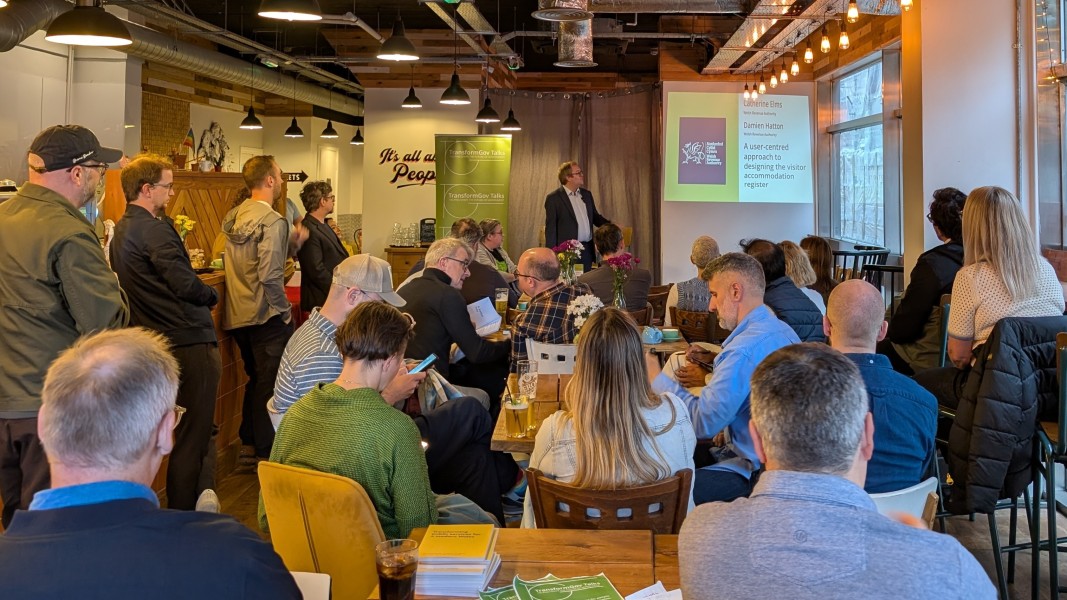
This month we brought TransformGov Talks to Cardiff for the very first time. At Transform Wales, we believe that Cymru is uniquely positioned to lead on public sector innovation: we are small enough to collaborate closely and move quickly, but big enough to deliver genuine national impact.
We wanted to co-host this event specifically to put a spotlight on the exceptional, pragmatic, user-centered work already happening across our public sector.
At last week’s event at The Bike Lock in Cardiff, two frontline teams showed us what happens when you put users at the heart of delivering services. The Welsh Revenue Authority (WRA) detailed how they designed Wales’s brand-new Visitor Accommodation Register, and the Shared Resource Service (SRS) shared how they overhauled council tax services for Blaenau Gwent.
Despite operating at completely different scales - one launching a national register from scratch, the other fixing a high-volume local government staple - their work highlighted three common themes that every public sector leader in Wales must grasp:
-
User-centered design is an operational necessity: Designing for real human behavior is the only way to build services that work first time.
-
Policy and legislation must be grounded in practical reality: Static policy fails at the point of delivery unless it is informed by how people actually live and work.
-
Failure demand can be designed out: Unclear digital services create massive manual backlogs and expensive contact centre calls that drain public resources.
Policy means nothing until it meets human reality
When the Welsh Revenue Authority was tasked with creating the Visitor Accommodation Register - a foundational piece of infrastructure underpinning the incoming visitor levy - they faced a massive operational puzzle.
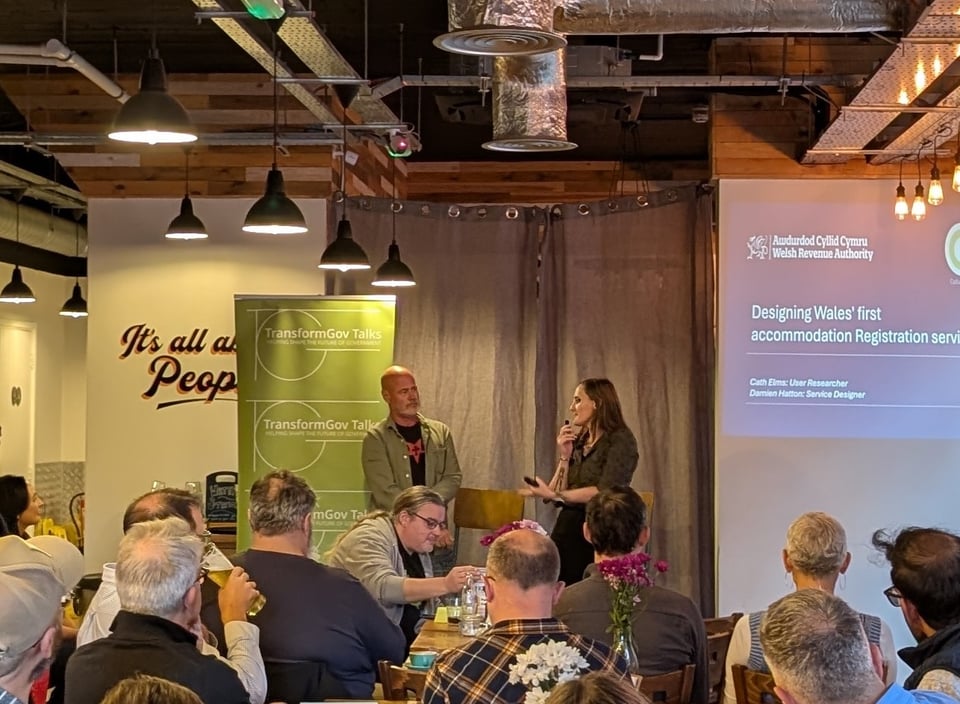
On paper, a policy definition of “visitor accommodation” looks straightforward. In reality, the Welsh tourism sector is wildly diverse. The WRA team found themselves designing a service that had to work for multinational hotel chains, retired couples renting a garden annex, glamping sites, floating hotel barges, and campsite owners who occasionally open a field for local scouts.
Initially, the team tried the traditional route: capture all the data required by legislation on a single, standardised form. It failed user testing spectacularly. Questions about named units that made sense for somebody operating several small cottages made zero sense for somebody operating a 300+ room hotel or somebody running a campsite.
Rather than forcing people into rigid administrative boxes, WRA conducted extensive user research to understand the actual language providers use to describe their businesses. They built dynamic logic into the service so users only see questions relevant to their specific setup.
Crucially, they used hard evidence from user testing to feed back into legal and policy teams, negotiating flexible interpretations of the legislation so the final service didn’t penalise providers or collect garbage data.
Failure demand is an operational choice
The second talk, from SRS, addressed one of the most high-volume frontline services in local government: Council Tax.
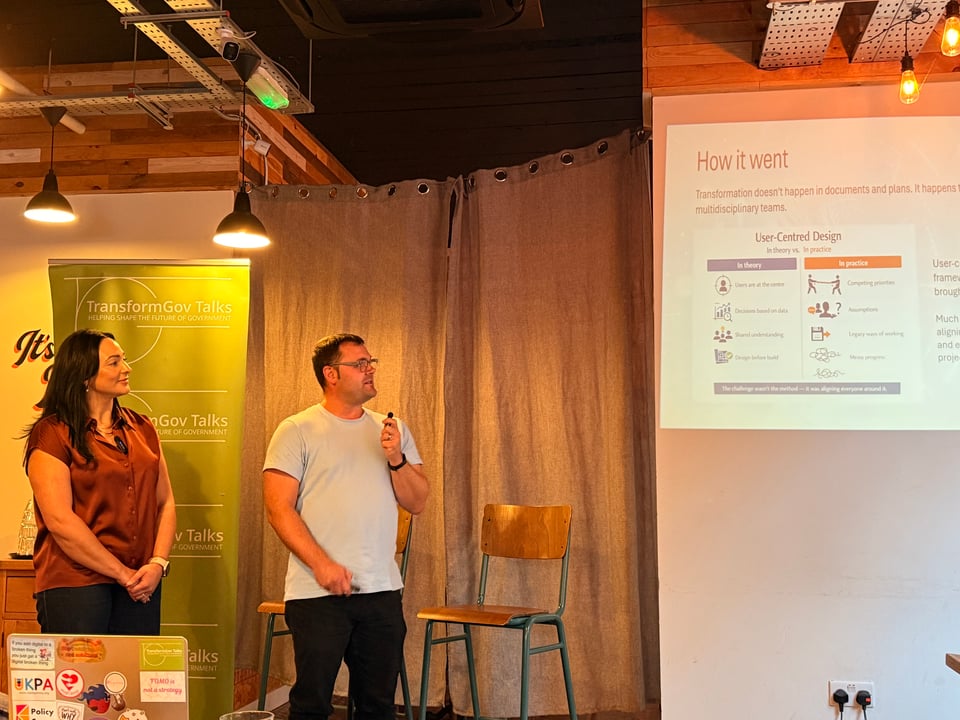
To understand why SRS’s approach was so impactful, it helps to understand the concept of failure demand: demand caused by a failure to do something—or do something right—for a person the first time. It is the single largest hidden drain on public sector capacity. When an online form is confusing, a process disappears into a black box, or something doesn’t go quite right, people contact us, ask questions, chase or complain. Every instance of failure demand is a frustrating experience for people, and leads to the public sector spending valuable time and money putting things right.
In Blaenau Gwent, handling council tax queries was creating a massive pressure of failure demand, eating up roughly 4,900 hours of staff time a year. Phone queues were long, digital uptake was low, and contact centre teams were burning out.
SRS didn’t try to paper over the cracks of a bad process with a shiny AI chatbot. Instead, they focused on rigorous service design. They mapped out end-to-end customer journeys, rewrote content in plain language using readability tools, adopted proven service patterns from the Centre for Digital Public Services (CDPS), and built 16 clear, accessible online forms.
The results speak for themselves. Since launching in February, digital uptake has surged by 380% compared to the previous year. Crucially, 40% of transactions now take place out of normal working hours - giving people the access they expect while removing thousands of avoidable calls from frontline staff.
Even better, Blaenau Gwent isn’t keeping this improvement to itself. SRS are now replicating this model across Torfaen and Monmouthshire. In a nation with 22 local authorities, stopping the endless reinvention of the wheel is our single biggest opportunity to save public money and improve services.
Building an open, user-centered future for Wales
The stories shared by WRA and SRS demonstrate that Wales has fantastic talent, and the capability to build world-class public services. As we highlighted in our report, scaling this across the whole country won’t be about buying new technology - it’ll require reforming our funding models, owning our digital plumbing, and giving multidisciplinary teams, like these, the space to deliver.
We want to thank both SRS and WRA for their commitment to working in the open and sharing their experiences. Working in the open is far more than a communications exercise - it’s a vital strategic tool that helps build trust, build understanding across organisations, and share lessons across the entire public sector.
If you missed the live event, you can catch up on all the insights by watching the full video recording on the TransformGov Talks website. Seeing the teams walk through their user testing iterations and live form designs is well worth an hour of your time.
Finally, an enormous thank you to everyone who made this inaugural Cardiff event such a success: Cath and Damien from the Welsh Revenue Authority, and Rebecca and Lee from the Shared Resource Service, for speaking so candidly and generously about their work; Gavin and David from TransformGov Talks for bringing the event to Wales; everyone who joined us in person or tuned in online; and the wonderful team at The Bike Lock for hosting us. The Bike Lock is a brilliant social enterprise supporting the local community in Cardiff, and we couldn’t have asked for a better venue or a warmer welcome.
Share your story
We want this month’s event in Cardiff to be the first of many. If you are working on a service transformation in Wales, if you want to present your work at a future event, or if you’re keen to help us host our next gathering, please get in touch with us.